
Looking at Our Baptistry Lamp
By Charles St. John
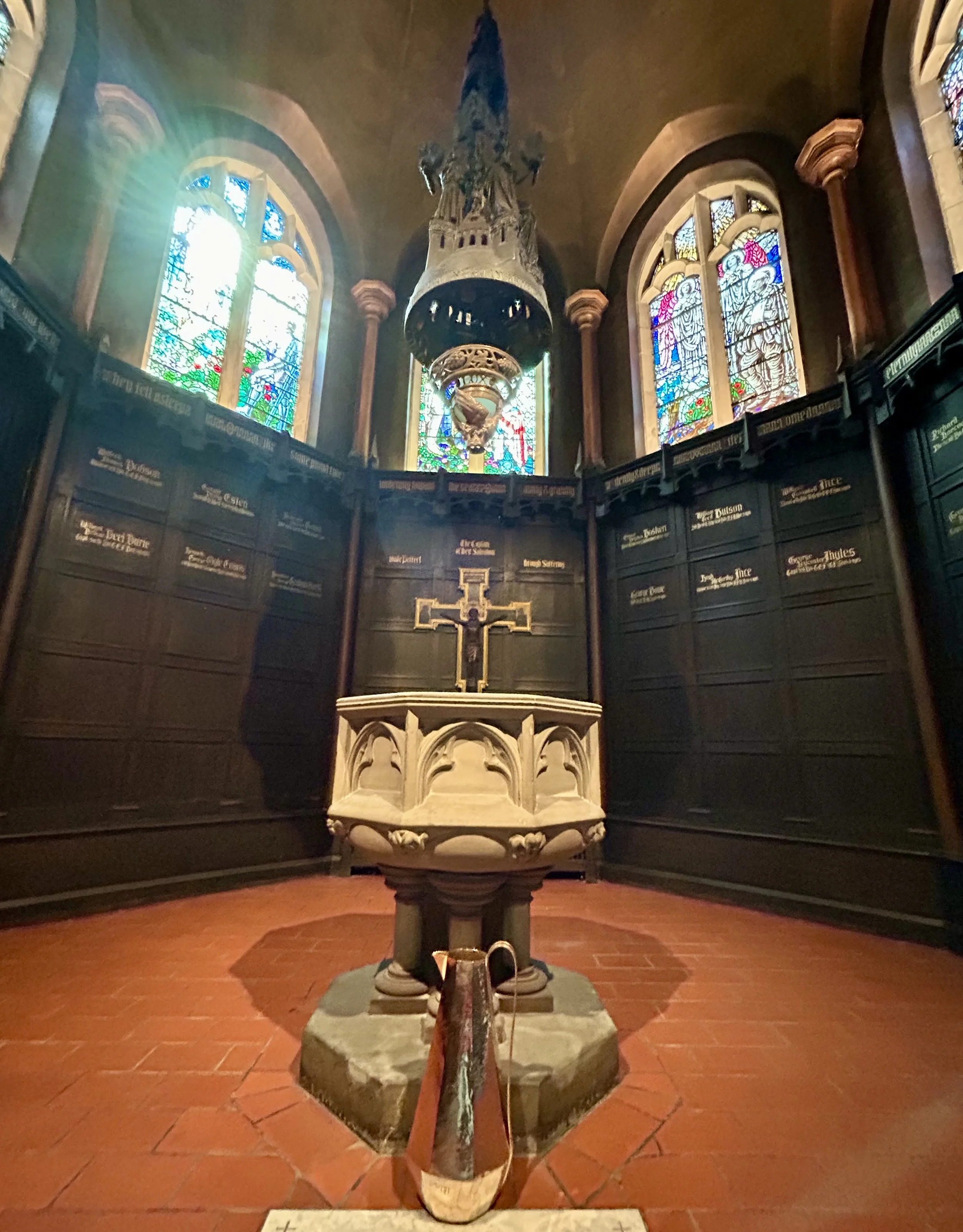
The lamp was designed by Henry Wilson, and was possibly intended for one of the two cathedrals of Zaragoza or for a convent in the same city. It was bought by Peter Larkin, and later gifted to St. Thomas’s by his son, Gerald, for the Eden Smith baptistry. But that does not satisfy my curiosity about it.
I have been curious about the baptistry lamp since first I saw it. If its twenty feet do not command attention, the detail must. But what are those details? So many of them escape not only the casual glance, but the dedicated effort to actually see them. The soaring height of this piece seems to defy our seeing. Perhaps there is an intention in that. Ought that which portrays the celestial be totally available to the terrestrial? Ah! I am a tenacious earthling, and I like having answers. Thus for them that share my defiant curiosity I have here set out as many of the details of this treasure as I possibly can.
The very top of the light resembles a ceiling boss. It begins with a gilded circle of embossed grape vines. Below this open-work design are attached four discs. These appear to be covered in mother of pearl. To these is attached an inverted dome made up of four inverted triangular shapes, each consisting of seventeen linked rectangles set in three rows of four, then a row of three, then two, and ending in a round disc. These pieces are finished in a blue enamel. Are these stylized grape clusters, or the sails of a ship, or the sails of a fleet of ships protected by Mary who from ancient times was hailed the “Star of the sea”? Each of the triangular devices is separated by a linked device consisting of one blue enamelled rectangle bearing a faint gilt design, attached at the bottom on either side to a gold disc. The discs in turn attach to a blue enamelled oval bearing some gilding and a coronet shape at the base. I have tried various methods to see these items more clearly, but without success.
The boss is linked by a chain to that which appears to be a gilt chandelier counterweight. This in turn links by chain to the top tier of the light proper. The counterweight ball seems to be ornamental, and is pierced by various shapes. I have not been able to detect any significance to the piercings.
The main body of the lamp is of bronze and in a bell shape made up of two parts. The parts are connected by five chains moving from the base of the top tier to an internal structure of interlocking arches surrounded by figures of saints and leaves.
The upper tier consists of a statue of the seated Virgin holding the Christ child, whose arm reaches out to her. This appears to be a type of Marian representation known as Seat of Wisdom [Sedes Sapientiae], the seated mother acting as a throne and holding out for us Wisdom incarnate. This statue sits on a round base. I have again been unable to clearly see the decoration here, but it appears to be a raised design of a crown of thorns within which are a heart and a sword. This design would then reference Simeon’s words in Luke’s gospel prophesying the suffering of Christ and its piercing of Mary’s heart.
The lower tier is a complex of saints and foliage arising up from a crenellated castle top. Is it a Spanish castle, or is it the New Jerusalem? Below the crenelations are a series of lancet windows through which light would have shone when the lamp was lit. The socket for a bulb can be seen inside this castle structure. The safety of electrical wiring from the early 1900s is a consideration of its own. The five saints are looking upward. Between each saint is a stem that rises into a cordate leaf bearing at the bottom an angel head. These filigree leaves rise above the heads of the saints, flare outward, and surround the open space above them. Can these be representative of the cherubim that uphold the divine throne, and of the seraphim that shield it? Do the saints look up to this divine openness or to Mary who holds in her arms the incarnate divinity? The wondrous capacity of symbols is precisely their lack of a meaning. They rather possess meaningfulness which evokes reflection and consideration more so than the achievement of logical and irrefutable answers.
The saints are identified by the script at the base of each. Beginning with the saint in line with the window bearing the image of an angel that stands before a kneeling knight and moving to the right they are: St. Teresa of Avila, reformer of the Carmelite order; St. Francis of Assisi, founder of the Franciscans; The apostle St. James the great, patron of Spain; St. Ignatius Loyola, founder of the Jesuits; and St. Dominic, founder of the Dominicans. The script itself is given as: STA.TERESA.S.FRANCESCO.SAN.TIAGO.S.IGNAZIO.S.DOMINGO
The script that runs around the base of this section of the light is from the beginning of a ninth century hymn to the Virgin, “Ave maris stella.” In the Roman Breviary it is assigned as a hymn proper to Vespers on feasts of St. Mary. That text reads: “Hail, Star of the sea, Mother of God, dear and ever virgin, happy gate of heaven. Taking that Ave of Gabriel’s mouth grounds us in peace, changing Eve’s name.”
The script as we have it reads:
AVE.MARIA.STELLA.DEI.MATER.ALMA.ATQUE.SEMPER.VIRGO.FELIX.COELI.PORTA.SUMENS.ILLUD.AVE.GABRIELIS.ORE.FUNDA.NOS.IN.PACEM.MUTANS.HEVAE.NOMEN.
There is a slight problem here. The rendition of the hymn’s verses on our lamp is either a misquote or a typographical error cast in bronze. The second word of our text ought to read “MARIS” not “MARIA.” If, as in some places it is said, the commissioners rejected this lamp, this may be the cause.
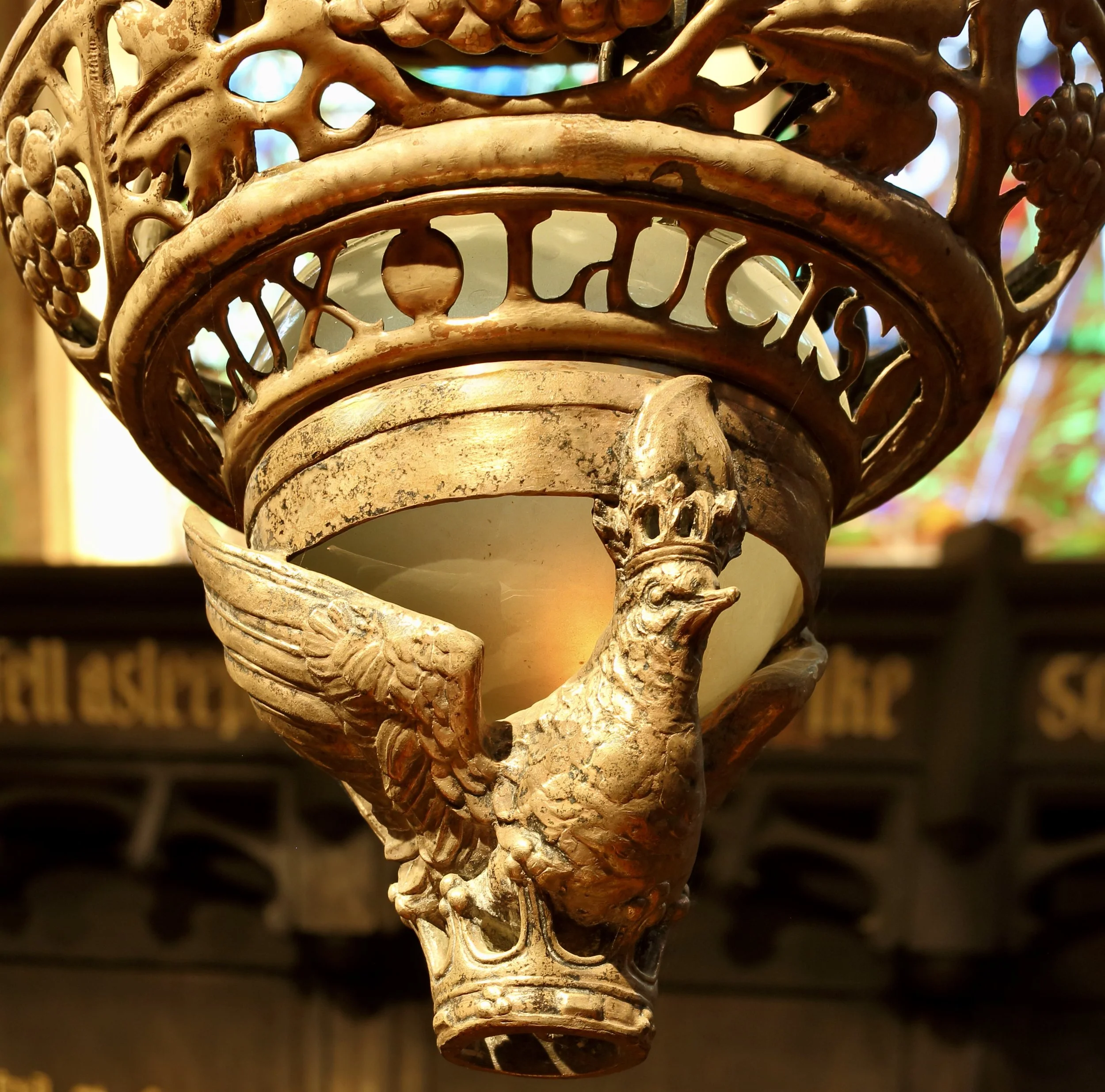
The lowest tier of the lamp is in a silver metal. It is connected by the chains that run through the above section. It is a bowl shape, the upper section of which is an embossed open-work of a grape vine. Below this runs a cut work script reading: LUMINIS.FONS.LUX., translated as “Light, fount of light.” These are the opening words of a hymn by the ninth century saint, Alcuin of York. In the Roman Breviary it is assigned as a hymn proper for Vespers. The bowl contains a white glass lamp. It is a globe shape with an opening at the top reminiscent of an oil lamp cover. The bottom of this structure is a crowned dove-symbol representing the Holy Spirit. Below this is another coronet containing a large metal link on which once hung a glass orb. Unfortunately, this was stolen.
The iconography of this lamp might seem better suited to a Marian chapel. However, every time we enter the church there is to our right this lamp in its bell shape ringing out hymns to the virgin, the seat of wisdom, star and guide in life’s journey, and to God, Light of light. Depicting the saints who surround us in worship, Mary who gives us Christ, the Spirit who bestows his grace, it is a fitting work to hover above that font where the waters of baptism are parted, and a new creation is begun.
I have endeavoured to present as detailed a description of the light as I can. Those sections which resist my seeing await another. It would undoubtedly be good for the parish archives to have a comprehensive photographic record of this lamp in all its parts. It would entail a camera better than that on my cell phone, a good photographer, and someone not wary of climbing to the heights necessary to capture the details, including perhaps the faces of the saints turned inward. It is not a project for this octogenarian given to the occasional dizzy spell, and so I invite a more agile soul to continue the adventure.
As an addendum I would note that in Henry Wilson: Practical Idealist, Cyndy Manton includes a photograph of another Henry Wilson lamp that closely resembles ours. There are several differences. There is a bronze ball below the level holding the Mother and Child, the leaves between the saints are absent, and the crystal ball at the bottom appears smaller than that which once graced our lamp—at least according to the photographs of our lamp in the volumes of the parish history.
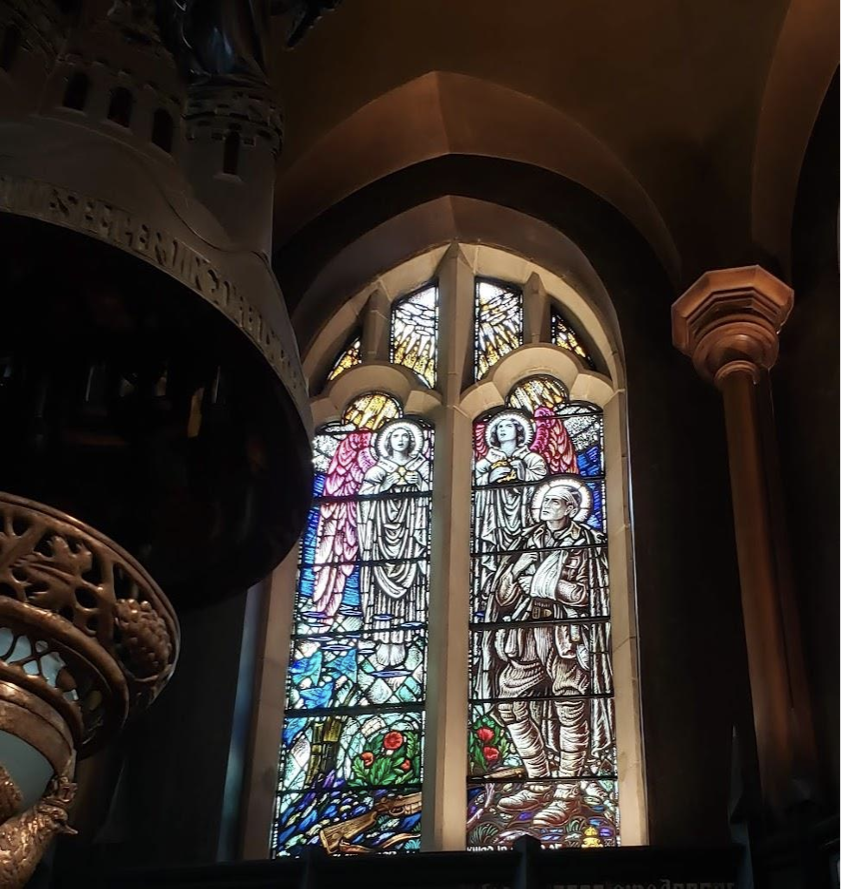
For more about the baptistry, see Carl Benn’s article on the Bromsgrove Guild windows.