
Dear People, Neighbours, and Friends of St. Thomas’s,
I’ve always thought that “Labour Day” was a funny name for a holiday, since we observe it by not engaging in any labour. Since I have only ever had vague notions about what it celebrates, this year I thought I’d educate myself properly about its Canadian provenance — and I discovered that the story begins a few blocks from where we worship every week.
In March of 1872, the printers of Toronto put down their moveable type and walked off the job, asking for a nine-hour day. Back then the usual workday was twelve hours. On the fifteenth of April, they marched from the Trades Assembly Hall on King Street, along Yonge to College, and finished at Queen’s Park. At the outset there were two thousand marchers; by the time they arrived, an estimated ten thousand had assembled in support, a fifth of the city’s entire population.
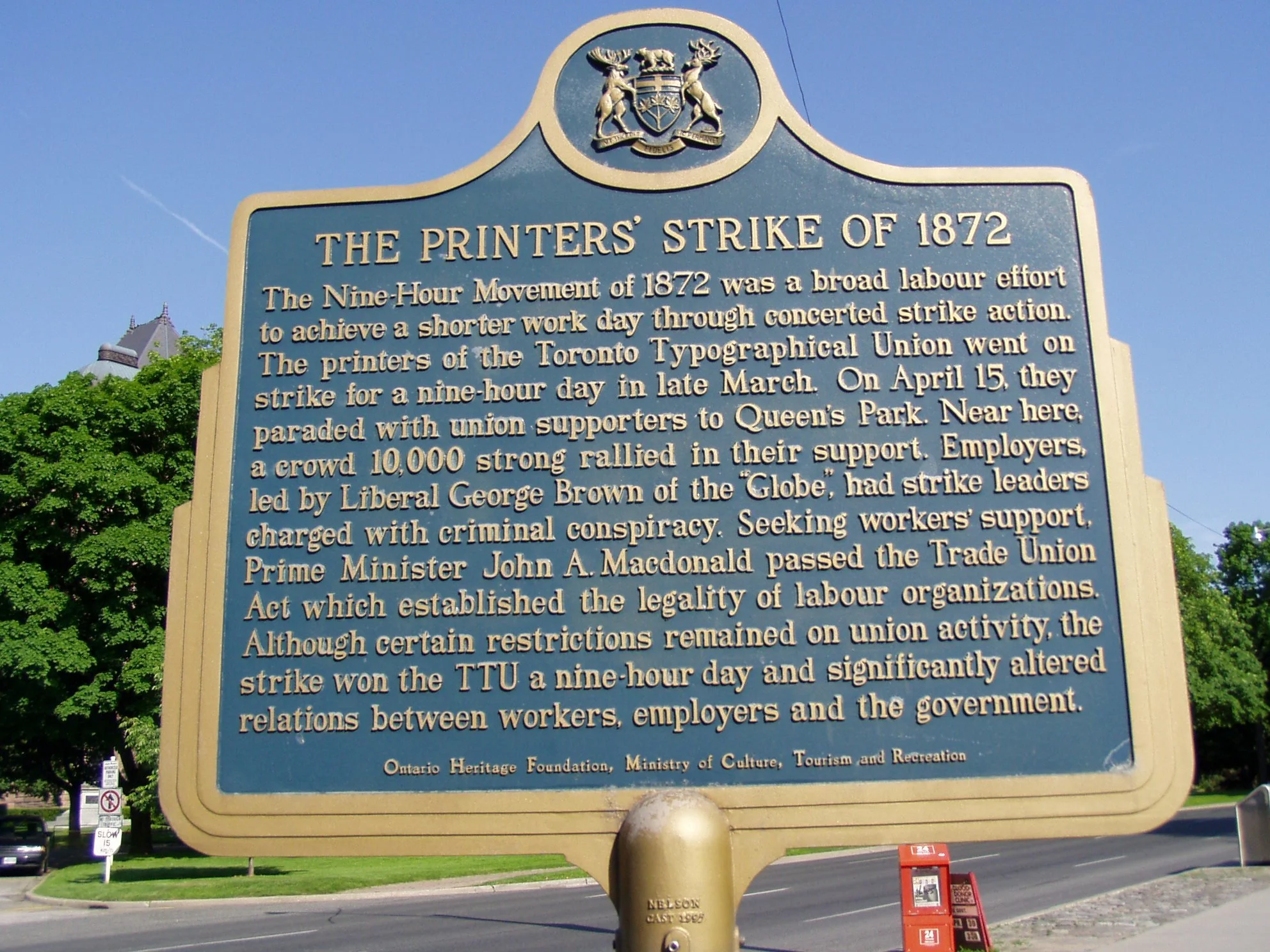
St. Thomas’s missed all of this by two years — we were founded in 1874 over in Seaton Village and arrived at 383 Huron Street only in 1893. We moved in around the corner from the site of the demonstration twenty-one years later, and exactly one year before Labour Day became a national holiday.
The printers’ most implacable opponent was George Brown, publisher of the Globe. The day after the march he had the entire 24-member strike committee arrested for criminal conspiracy. Union activity was, at that moment, a crime in Ontario — not by any recent decision, but by inertia. The legislature had adopted the criminal law of England as it stood in September of 1792 and then simply left it on the books, so the printers were jailed under a law that England itself had repealed the previous year. Their crime was “combining.” Twenty-four men were arrested for agreeing with one another about the importance of time off the job.
Despite George Brown’s determination, his opposition to organized labour was undone by a rival politician, Sir John A. Macdonald, who seized the opportunity to humiliate his foe. Macdonald introduced legislation three days after that historic 1872 march to legalize unions, and by June it was law. So the right of Canadians to organize was secured, in large part, out of spite. There’s a lesson in there somewhere, but I don’t think it’s a credit to humanity.
This is why the older word for our work is vocation, a calling. Not “what I do for money” but “what I have been given to bring forth.” Most of us live somewhere between the two on most days. If we’re lucky, we work forty years to fund twenty of not working. We dedicate our time for eleven months to purchase one. We have taken sabbath — which God set at one day in seven, woven into the fabric of the week — and postponed it to the far end of life, where we hope there will be knees left to enjoy it. And this is only true of those of us privileged enough to have retirement savings, pensions, and paid vacations. Rest was meant to be a rhythm in the here and now, not a reward for the fortunate few.
The printers were not asking for a share of the Globe. They were asking for three hours of their own lives back, per day, and it took the better part of a generation to get them. What is being asked of us today is heavier, slower, and nowhere near finished, and it is properly called labour: demanding, purposeful, and aimed at the handing back of our common and basic human dignity. So our labour is clear: it is the labour of handing back.
Which is, after all, what we do here every Sunday. We take up bread and wine — grain somebody else grew and ground, fruit somebody else picked and pressed, the work of human hands from beginning to end — and we set it on the altar, and God hands it back to us as himself. Human labour ascends to God as our prayers ascend with the smoke of incense, and descends to us as grace. Whatever else the Mass is, it is a weekly rebuttal of the idea that labour is the thing we escape from, and a weekly rehearsal of the return of everything that was taken away.
So: two things for Monday.
First, name three people whose labour you will depend on that day and will not see: whoever stocked the shelves, whoever is driving the streetcar, the nurse on shift, the hands that produced what is going on the barbecue. Pray for them by name if you know their names, and by trade if you don’t.
And second, ask one honest question about your own labour, or about the labour you purchase. If the answer is uncomfortable, do not merely feel bad about it. Feeling bad is not a spiritual discipline. Discerning what labour God might be calling you to — what the shape of your true vocation might be — is worth taking the time to do, no matter how many hours it takes.
Yours in Christ’s service,

Nathan J.A. Humphrey+
VIII Rector
