
What’s a Parish?
Dear People, Neighbours, and Friends of St. Thomas’s,
This past week Fr. Micah and I spent a few days in nearby Mississauga at the inaugural Canadian Gathering of Leaders, a conference for clergy in the Anglican Church of Canada sponsored by The Living Church, on whose Foundation I serve. One of the most thought-provoking talks came from Bishop Alexander Pryor of the Diocese of the Arctic. His subject was how a parish discovers its mission, and he opened with a bold claim: Parishes are geographical. A parish, he said, is “a geographical area claimed as a mission field,” and its mission is not first of all to its own members but to the place where God has put it. Non-geographic parishes, in his words, are “a product of the world we live in—not a feature we would hope to see in a thriving Church.”
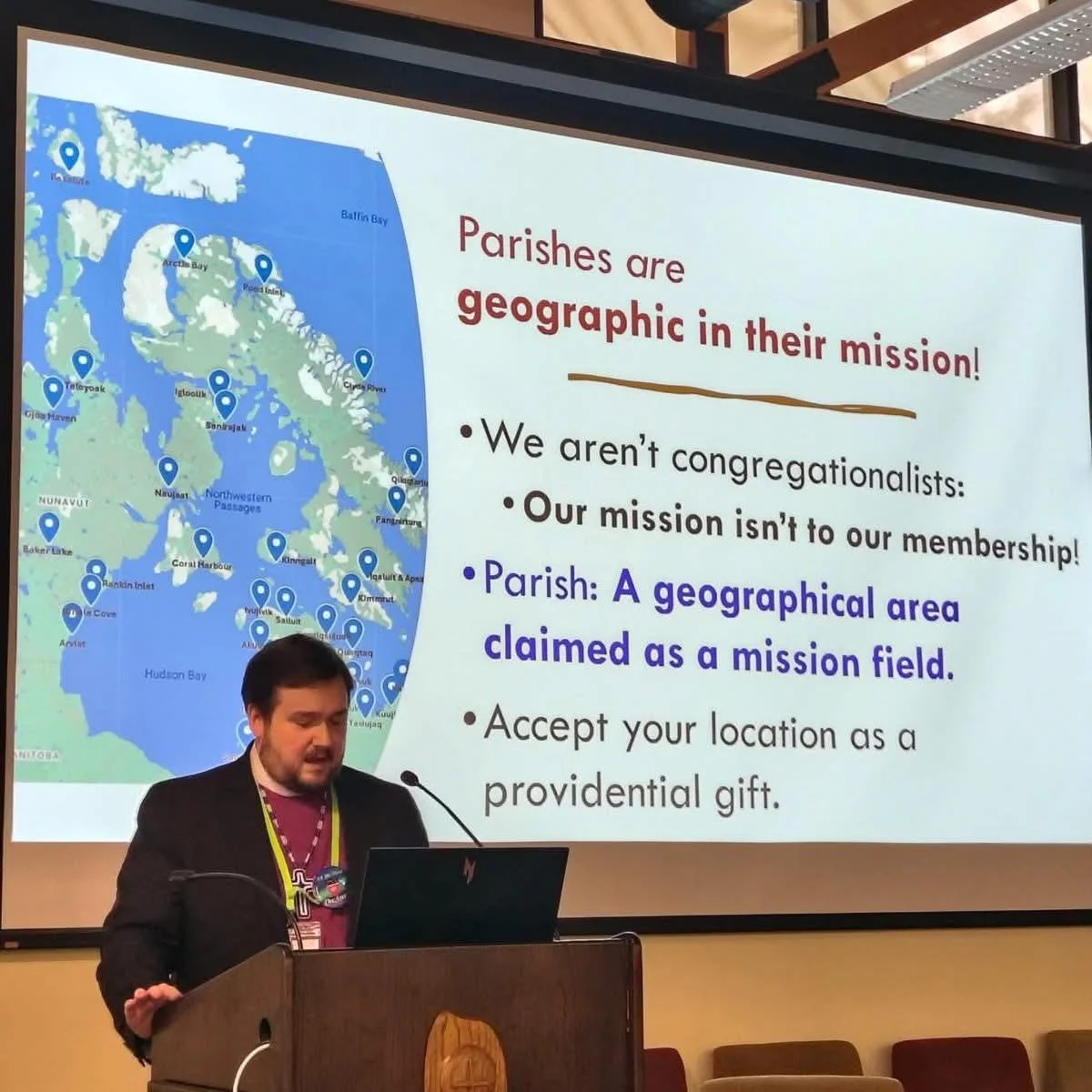
Bishop Alexander Pryor of the Diocese of the Arctic at the Canadian Gathering of Leaders. Photo via Chris Evetts on Facebook.
Bishop Pryor observed that it’s not unusual nowadays for people to drive past several other parishes to reach the one of their choosing, especially what are often called “destination parishes.” These usually fill some “niche” in the church, and while there’s nothing wrong, per se, with “niche parishes,” they aren’t the ideal. I was sitting at the back of the room, and as soon as the phrase “niche parishes” came out of the bishop’s mouth, several people turned around and looked pointedly at me with arched eyebrows and wry smiles. I couldn’t fathom why.
Surely St. Thomas’s isn’t simply a “niche parish,” is it? One priest in the row in front of me gently pushed back on the bishop’s old-fashioned definition of a parish as a distinct geographic territory, suggesting instead that a parish is defined by the distance one is willing to travel on a Sunday. That set me thinking that, with our livestreaming ministry, even his definition is old-fashioned.
The truth of the matter is that I really appreciated Bishop Pryor’s emphasis on the essentially geographical nature of parish ministry. It’s true that many of you, drawn by the liturgy, music, and preaching found here, cross the city to be at St. Thomas’s on a Sunday or join us via livestream. Even so, a parish like ours does well to ask what it owes the few blocks around Huron Street.
When the talk ended, I thanked the bishop for his emphasis on geography and held up my phone, which displayed a photograph of a map of our parish boundaries outlined using a thick red Sharpie. I keep it among my favourites on my photos app as a reminder of the geographic reality of this parish. In the moment, I neglected to mention that just a couple of weeks ago, Fr. Micah and our lay catechist, Gideon Strauss, spent about two hours walking the bounds of the parish in prayer, a modern version of the old custom of “beating the bounds.”
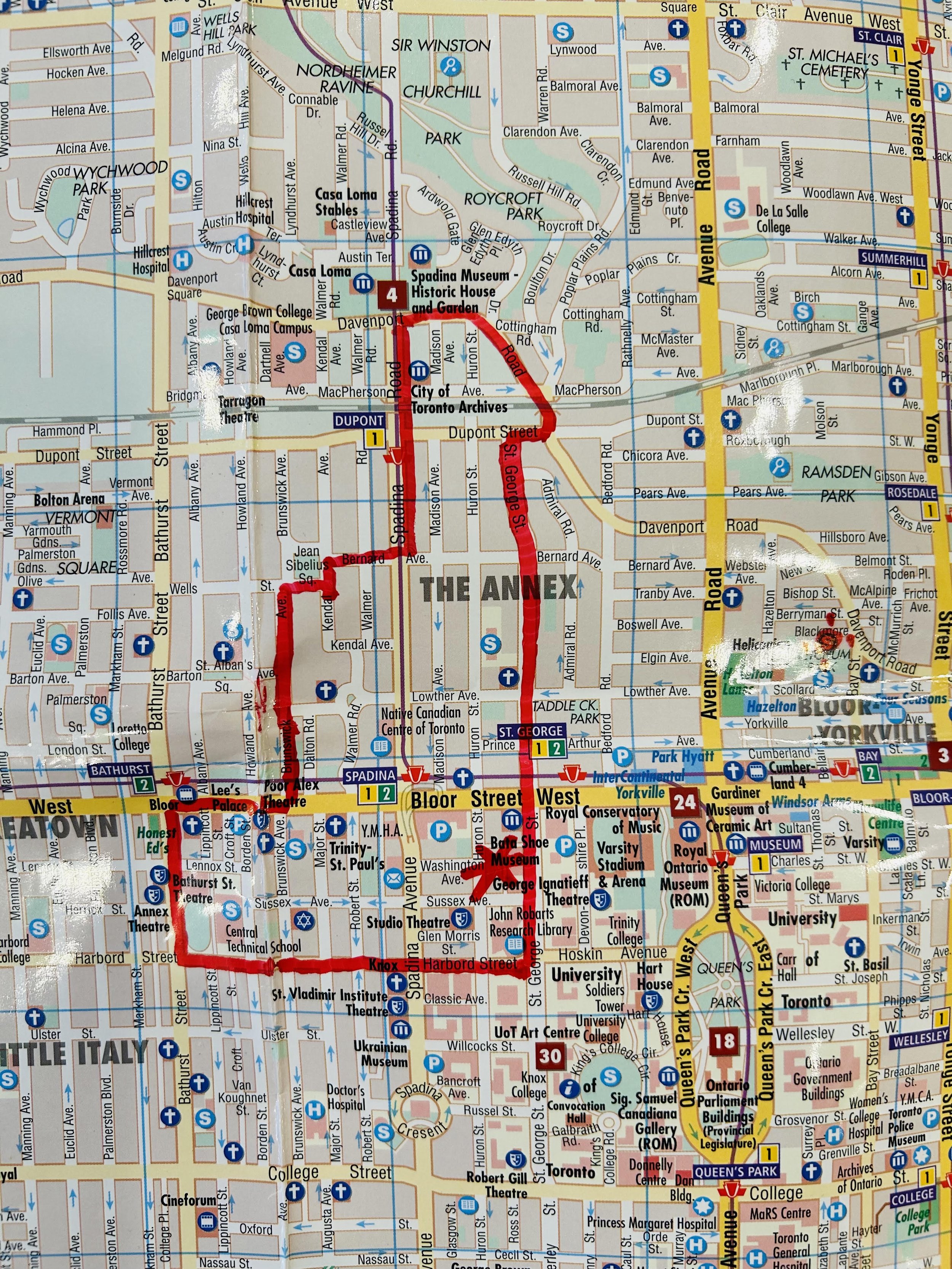
Our parish boundaries look to me like a water pistol pointing upwards.
But I did inform the bishop that I write a letter every week addressed to the people, neighbours, and friends of St. Thomas’s. The “people” are those who consider themselves members of this parish, whether they attend services here frequently or rarely. The “neighbours” are all those who live near us, whether strictly within the canonical bounds of St. Thomas’s parish or not, and regardless of their faith commitments. And the “friends” are those near and far who care about us and want to stay connected, many of whom belong to what I think of as our “alumni association.” Together, our people, neighbours, and friends form a network of love and support, and we need all of them—all of you—to live into our identity and carry out our mission.
I also couldn’t resist mentioning the Cornerstone Project, which is grounded quite literally in the needs of our geography: We cannot say that all are welcome if not everyone can get into the church and the parish hall. I’ll admit, though, that an accessible entrance is only a beginning. It lets the neighbourhood in, while the bishop’s challenge was about the parish going out. If it were only about getting in, it would be about the destination rather than the journey, spiritually as well as physically. A door that opens both ways leaves us no excuse for staying inside.
On the drive home, Fr. Micah and I counted up the number of times people at the conference had approached one of us to testify to the role Smoky Tom’s had played, or continues to play, in their lives. I think it might have come as a bit of a surprise to Fr. Micah, but it wasn’t surprising at all to me. I’ve spent the past five years being thanked regularly for the presence and mission of St. Thomas’s over the decades, including the decades before I was even born. So many people have a story to share about St. T’s. They found us as students at U of T, or while discerning a call to ordination, or as seminarians at Trinity or Wycliffe, or were simply once parishioners for a season, and some still drop in on us whenever they can.
In fact, tomorrow we’ll have a visitor of note: Bishop Pryor himself, who let me know that he will be attending High Mass before returning to the Arctic. (His three suffragan bishops will each attend a different Toronto parish as well, but he had dibs on St. Thomas’s.) If you see him, I hope you’ll give him a very warm welcome.
It turns out that at St. Thomas’s, there’s not as much difference between the geographical parish and the niche parish as one might at first think. Bishop Pryor urged us to “accept your location as a providential gift,” and St. Thomas’s has been doing that for over one hundred and fifty years now. We began in 1875 as a mission in Seaton Village and moved to Huron Street in 1893, which today is but a few minutes’ walk from two Anglican theological colleges, the Toronto School of Theology, and one of the undisputed great universities of the world. Not all of the campus lies within our historic parish boundaries (St. George Street marks our eastern edge), but all of it is unquestionably within our neighbourhood. Our character is bound up with where we stand. Move St. Thomas’s to the suburbs and you would have a different church, and far fewer stories of gratitude.
Jesus said that the kingdom of heaven “is like yeast that a woman took and mixed in with three measures of flour until all of it was leavened” (Matthew 13:33). Yeast works by being hidden in one particular lump of dough, and its effect is felt far beyond the spot where it was put. Whatever good St. Thomas’s has done for the Anglican Church of Canada and beyond, it has done not in spite of our location but because of it. Generations of young people have passed through these doors on their way to becoming something. By God’s providence a good many of them became clergy, musicians, and leaders in the church, and many more became the sort of faithful lay people every parish needs if it is to thrive, wherever that parish may be, in Toronto or in the Arctic.
That brings the bishop’s question home. Within the red lines of our parish map are students and Annex households, the shops and restaurants of Bloor Street, the Native Canadian Centre, the International Estonian Centre, all of Robarts Library, the Bata Shoe Museum, and a great many neighbours who have never set foot inside St. Thomas’s. Bishop Pryor suggested a simple exercise: list everything we are already doing that we don’t think of as ministry, but which, on reflection, is. I would love to see your list. What are we already doing for our neighbours, and what might God be asking of us next?
The Psalmist sings, “The boundary lines have fallen for me in pleasant places; I have a goodly heritage” (Psalm 16:6). Ours happen to be drawn in red Sharpie on a well-worn map of the city, and I am grateful for every street inside them, and for all of you, near and far, who call this place home.
Yours in Christ’s service,

Nathan J.A. Humphrey+
VIII Rector
P.S. Speaking of parish boundaries, with all the changes that have happened over the years, for a variety of reasons our parish boundary maps are out of date. Our regional dean, Fr. Rob Mitchell, is chairing a diocesan working group to address this, and our deanery will be asked to provide input this fall. So perhaps I will finally realize my expansionist dreams!
