
Dear People, Neighbours, and Friends of St. Thomas’s,
On Thursday night, our late parishioner Nigel Wright’s former employer, Onex Corporation, hosted a reception for about a hundred and eighty-five people in the Terrace Room of the Gardiner Museum. (Some of us know this room better as the location of Clay restaurant.) The organizers kindly invited me to offer a few remarks and to bring along some materials and parishioners representing the Nigel Wright Memorial Fund, as well. Our Cornerstone Campaign co-chair, Michael Rowland, and consultant from M&M International, Sarah McCarthy, staffed an information table and handed out programs and brochures. Mingling amongst the other guests were honorary co-chairs Alix Arnett and John Fraser, along with campaign ambassador Larry Beckwith, as well as Nigel’s close friend from their St. Thomas’s days, Dr. Suan-Seh Foo. I am grateful to all of them for supporting St. Thomas’s presence at this event.
When I learned I’d be the last speaker on Thursday night — following Onex founder Gerald Schwartz, then Nigel’s long-time friend Jerry De Melo, then former prime minister Stephen Harper, then current prime minister Mark Carney — I recalled what I was told upon entering Yale Divinity School back in 1994: that the motto, “For God, for country, and for Yale,” was the dictionary’s example of “anticlimax.” Talk about a suddenly anticlimactic speaking order! But then I remembered that someone else once said, “The first shall be last, and the last shall be first,” and I was somewhat consoled.
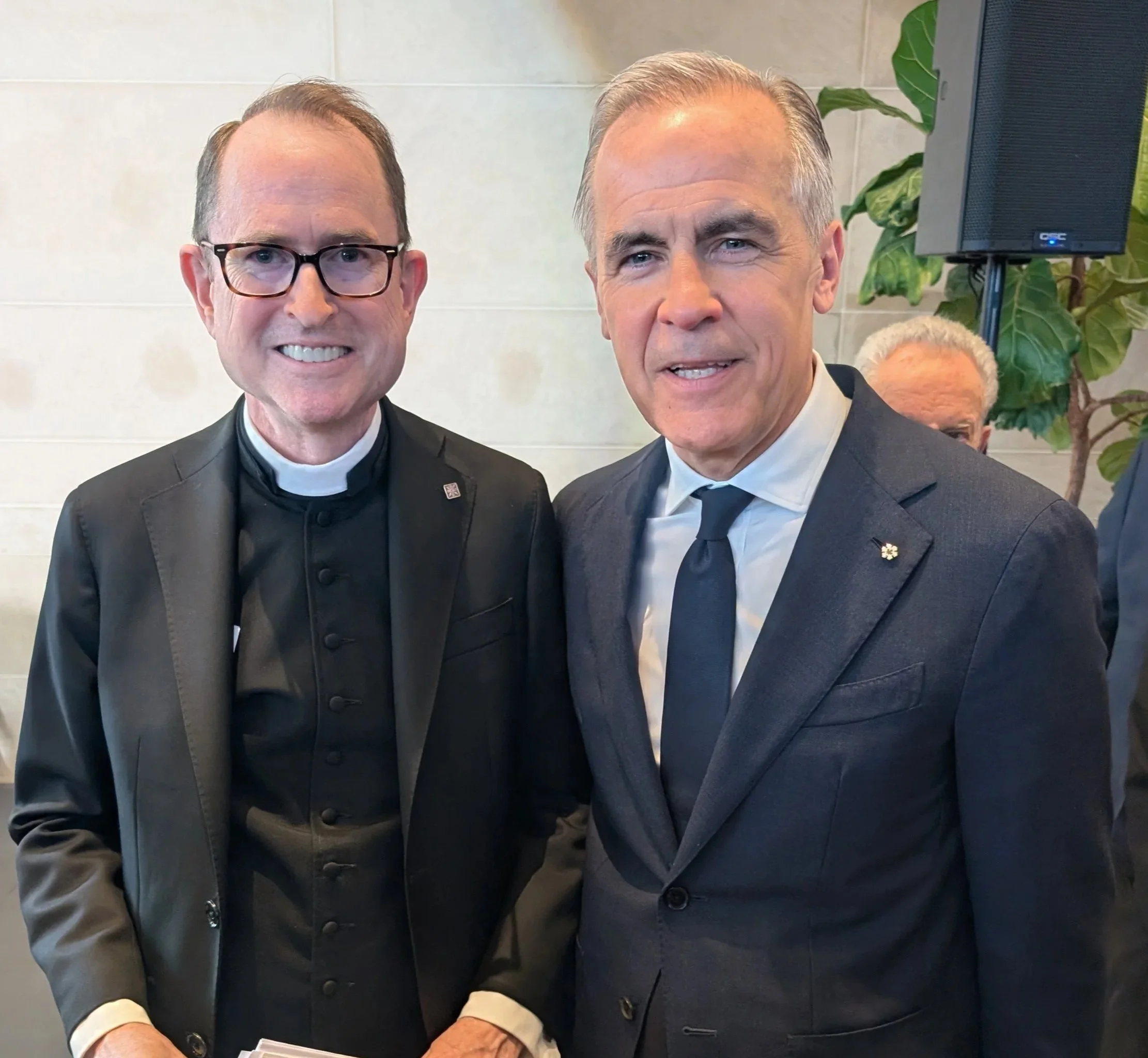
Fr. Humphrey with Prime Minister Mark Carney on Thursday, June 4. They were among the speakers at the Onex Corporation memorial reception in honour of Nigel Wright. (Photo: Sarah McCarthy)
I reflected in my remarks that Nigel’s dedication to serving the homeless and food insecure in Toronto, in Ottawa, and in London every single Friday was a testament to his understanding that the first shall indeed be last, and the last shall be first. Gerald Schwartz noted that it was unusual to have both a former Conservative prime minister and the current Liberal prime minister present to honour the memory of the same person, but this was one of those rare occasions when political convictions about policy were set aside to focus on the personal character and impact of a human being whom the speakers recognized as being motivated by his deep Christian faith and unwavering charitable commitments.
We were not there to canonize St. Nigel of Onex, however. Jerry De Melo, Nigel’s decades-long best friend, dispelled any myth of Nigel as a perfect human being. Jerry has kindly allowed me to share a couple of anecdotes that prove that point!
First, Jerry recounted how one year, “four of us went on a canoe trip in Algonquin Park. In spite of the time he spent at the office, Nigel considered himself the best outdoorsman and insisted on taking the lead canoe — and the map. After we’d paddled for three hours, he sheepishly admitted that he’d taken a wrong turn and we had to circle back. We had had a late start and so we ended up having to camp right next to where we’d parked the car. The man who counselled prime ministers and business leaders couldn’t steer us in the right direction. We had a good laugh about it. Nigel was always able to laugh at himself — but nothing ever weakened his resolve. He still insisted on leading for the rest of the trip.”
Another story Jerry told took place closer to home: “Nigel and I shared a house in the Annex for a few years before I moved to England. We had a great deck and the only time we ever really argued was when we had friends over for a barbecue. That’s when the differences in our backgrounds became evident. Seems the English worry about things like portion sizes, and whether there’s a vegetable. The Portuguese have no such concerns. He always thought I was buying way too much food. We’d be standing in Loblaws arguing for far too long about how many baguettes we should buy, even though he was always the one who ate the most. He may have shopped like a WASP, but he definitely ate like a Portuguese.”
On the subject of food, I was to dine with Nigel in London in mid-October last year. Nigel and St. Thomas’s were all set to finalize a seven-figure gift in his lifetime toward our Accessibility Atrium, so that, among other things, the guests of our Friday Food Ministry who use wheelchairs and scooters could finally access our Parish Hall. Sadly, that dinner conversation never took place, as Nigel died on the last day of September. Since Nigel’s death, our Friday community dinner guests have doubled in number. Nigel understood that even the best public policy solutions need the efforts of private citizens to mend the social safety net wherever it is most strained. The Accessibility Atrium is our commitment to improving our capacity to serve all people.
To that end, the more than one hundred external donors to the Nigel Wright Memorial Fund have made it clear to me that it would be a fitting tribute to Nigel’s life of faith, intellect, and service to name the atrium in his honour, which is the very heart of the place that shaped his soul. But the Churchwardens and I can only consider such a request if the space is not encumbered by debt, so this will not happen unless at least five million dollars is raised for that specific purpose from external donors.
And with the permission of Nigel’s partners at Onex, I was pleased to announce on Thursday that they are committed to making a significant contribution to the atrium in honour of their late colleague. Alongside their gift, our external donors have already contributed nearly seventy thousand dollars to the Nigel Wright Memorial Fund; by the end of the summer, we hope to pass the one-million dollar mark. I invited those present to ensure that Nigel’s last charitable project is completed and named in his memory, as we all continue to be inspired by Nigel’s life of generous public service and private enterprise for the common good.
Of course, it remains to be seen whether this goal will be achieved. If so, this would be the third space named after a St. Thomas’s community member, the others being the Father Freeland Room and the John Tuttle Music Library. The latter of these two will be relocated to larger accommodations as a result of the atrium project, and I am looking forward to bringing all of the parish’s music holdings under one roof. We are currently discussing where the new and improved John Tuttle Music Library will go, as convenience of access and climate control for the collection are the top two priorities we’ve identified, and we will continue to consult with all stakeholders along the way. So we will have at least one new space named for a beloved St. Thomas’s community member who is, thankfully, still among the land of the living.
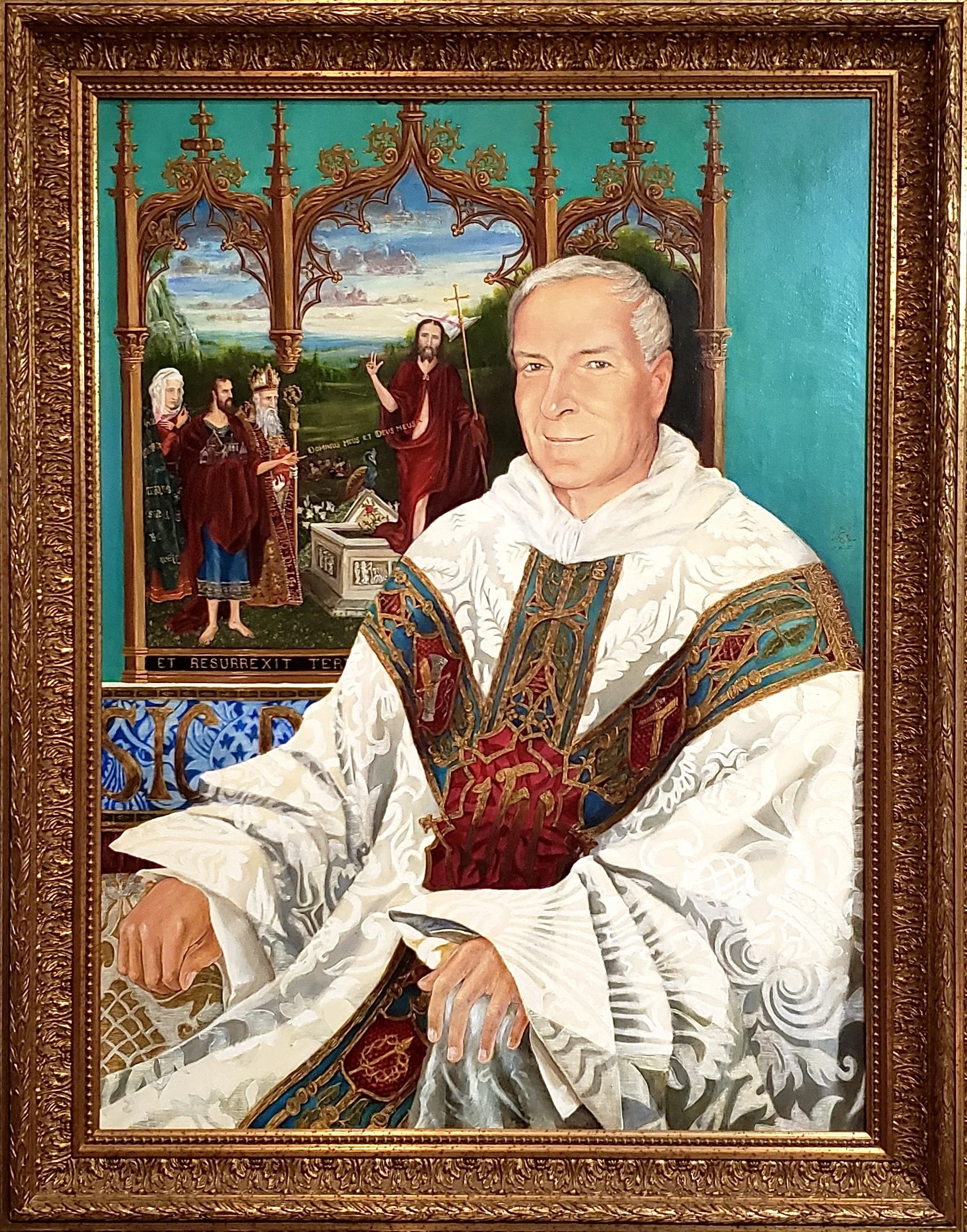
This portrait of The Rev. Canon Brian Freeland, painted by Dr. Suan-Seh Foo, hangs in the Father Freeland Room, adjacent to the Parish Hall. (Photo: Fr. Humphrey)
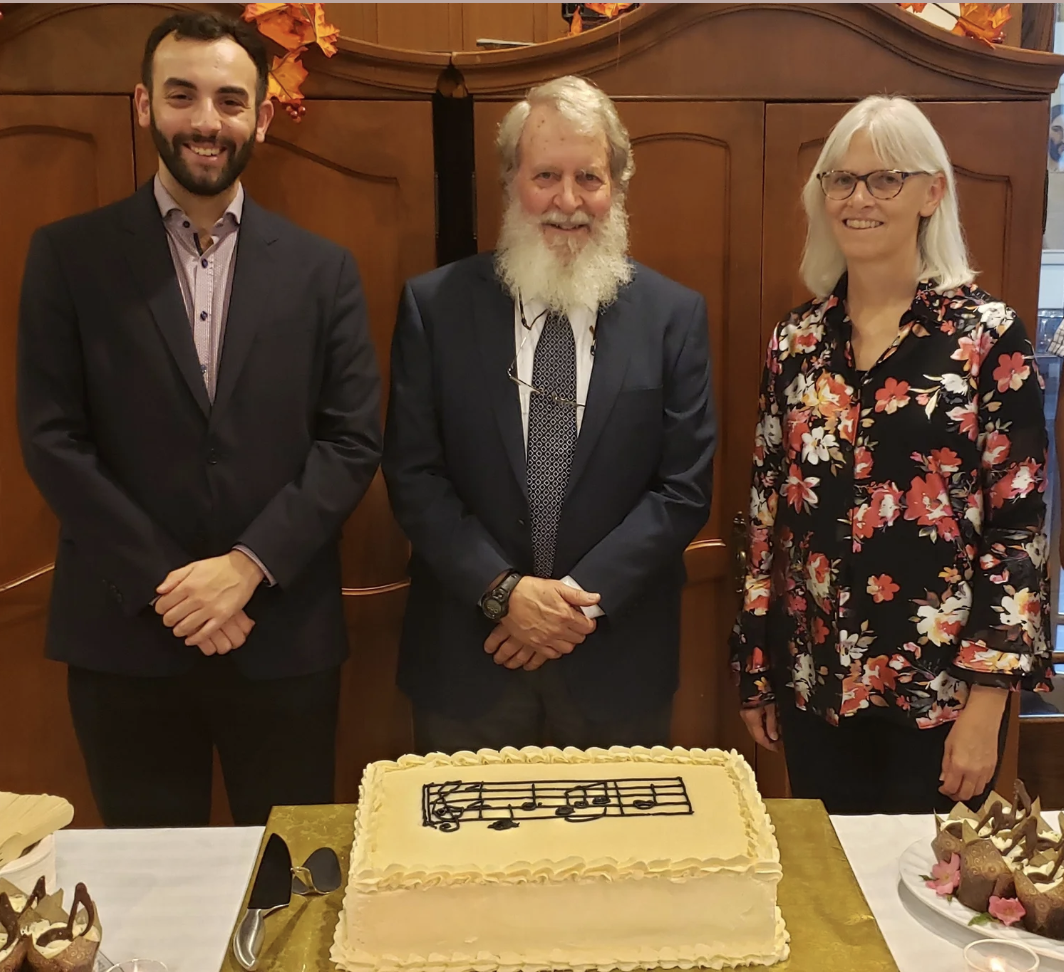
The music library was named in honour of John Tuttle (centre) upon his retirement as organist and choirmaster. He is pictured here with our current staff musicians, Manuel Piazza (left) and Elizabeth Anderson (right). (Photo: Julia Armstrong)
Whether the Accessibility Atrium is named or not, however, it will be built. I am looking forward to a brand-new space that will serve all sorts and conditions, and that will seamlessly sew together our worship, our fellowship, and our solidarity with those who — unlike Nigel and almost all of us — will indeed be first in the Kingdom of God.
Yours in Christ’s service,

Nathan J.A. Humphrey
VIII Rector