
Where There’s Smoke
Dear People, Neighbours, and Friends of St. Thomas’s,
When I returned to Toronto last week, I was looking forward to writing a scintillating account of my vacation for sharing through The Thurible. Charming anecdotes about life in provincial France (we visited the village that is rumoured to have inspired the setting for Beauty and the Beast) were to be balanced with complaints about the indignities of travel and the heat wave that met us when we arrived (our first day was the hottest in the nation’s recorded history). My letter was going to include a healthy sprinkling of spiritual observations sparked by visiting a couple of millennia-old pilgrimage sites. Readers would have come away sympathetic, envious, and edified. I only needed to write the thing, which I could do once the Sunday services were over.
Partway through those services, I realized I had to scrap the idea. Actually, I can pinpoint the moment I abandoned it — a moment you may also remember if you were at High Mass. Just after our guest preacher began the sermon, the fire alarm went off. It wasn’t easy to think because of its ear-splitting peals, but a couple minutes in, I realized that, among other things, the topic of this week’s letter wasn’t going to be what I’d planned.
As the alarm sounded, one of the next thoughts that went through my head was, I confess, whether this might be the Rector’s idea of an initiation for the Associate Priest — a kind of “trial by fire alarm”? After all, it was the first Sunday of his vacation. Might it be his idea of testing the mettle of his colleague? That his last sermon had been about “sacred fire” had not escaped my notice. I was reassured, however, when I was told that this had never happened before; I laid my suspicions aside entirely when he sent a note of encouragement after the service.
Even in the Rector’s absence, of course, I was not left comfortless. Several lay leaders sprang into action. Two wardens at the front of the church — Kevin Blagrave, who was singing in the choir, and Andrew Smith, who was serving as an acolyte — went to investigate. Organist and Choirmaster Elizabeth Anderson, who knows our buildings better than anyone, followed. Property expert Rob Kennedy and acolyte Vince Meade pitched in, while Parish Administrator Christine Cover and Property Committee Chair Lorne Swan assisted remotely.
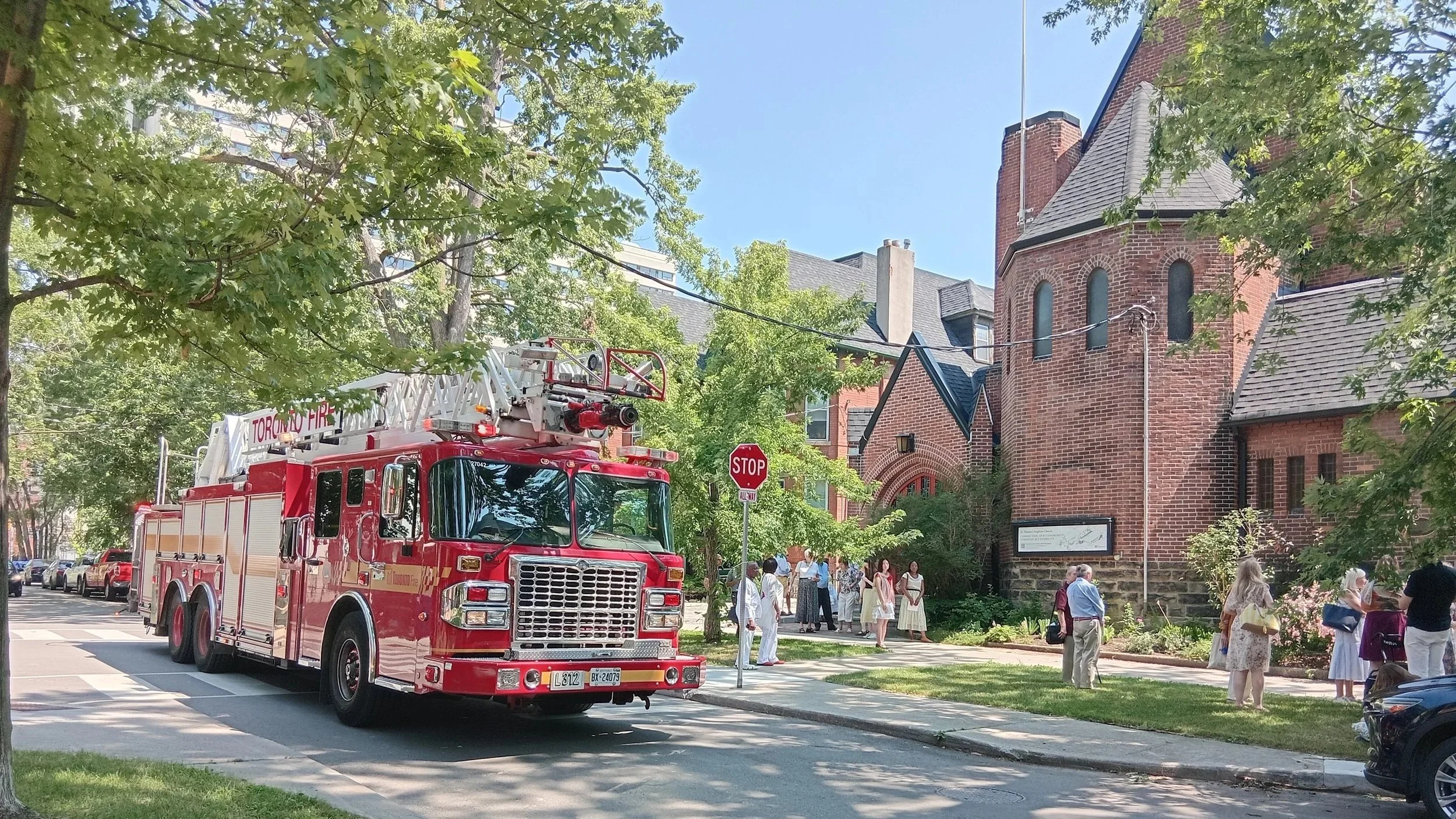
Mtr. Catherine Sider-Hamilton was impressively poised both during the fire alarm and after she returned to the pulpit. As she noted, our mid-Mass field trip outside might just have piqued someone’s interest in what happens at this church. It might not have been the approach most of us would have chosen, but stranger things have brought people into the church.
In fact this wasn’t the first time this had happened to me during a service. A few years ago, the fire alarm went off at Grace Church on-the-Hill when I was preaching. It was Christmas morning (of all times), but the alarm was shut off relatively quickly; no firefighters featured. Last Sunday’s experience was more exciting. If there’s learning for me, it’s to be a little more prompt in responding, as if it were a real fire. After all, I’d had the chance to visit Notre-Dame de Paris on my trip, a startling reminder of what can happen. (More about that beautiful cathedral during this Sunday’s sermon.)
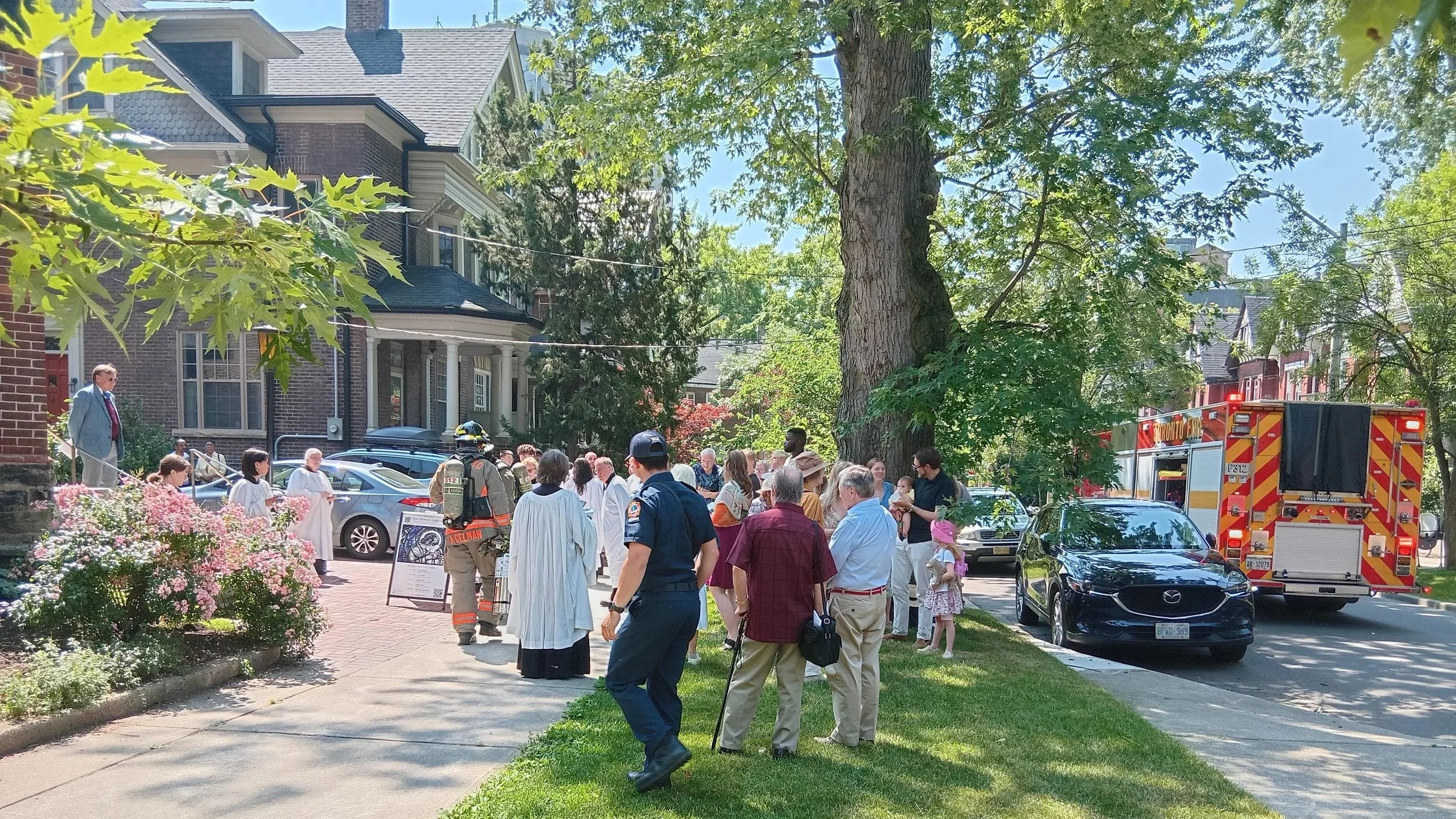
Fortunately, the only fire burning was the one in the literal thurible, though it took a few minutes to confirm we were clear of danger. Staring up at the clouds of incense in the rafters, one firefighter was ready to put up a ladder in the nave to investigate. When we assured him that, really, it looked like this every week, it took him a few moments to accept that this was normal. Were we comfortable with all that smoke? “Yes,” was the answer, though admittedly this response came from the person who had been swinging the thurible! I had to stop myself from adding anything about the church’s nickname.
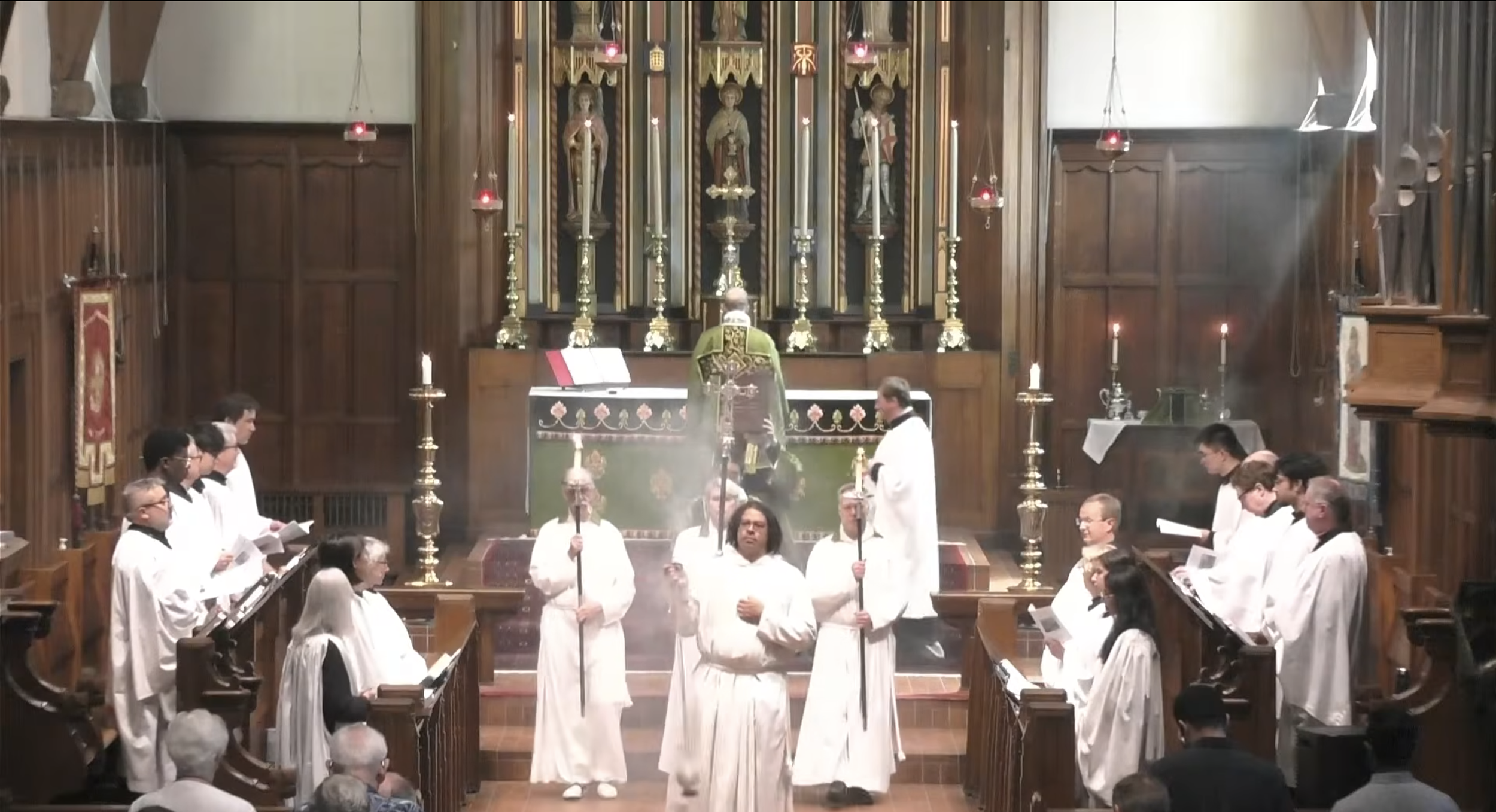
Gospel procession, just a few minutes before the alarm went off.
While it’s hard to tell with 100 per cent certainty what tripped the detector, an open door into the breezeway may have been the culprit. It had been propped open to keep air coming in to the (hot) nave, but the air going out may have been smoky enough to set off the sensor. That door won’t be open in the future. Smoky Tom’s already has a Fire Safety Plan (as we’re required to), which will need updating as the Accessibility Atrium project takes shape. Andrew Smith will be undertaking a review of that plan, and parish leaders will be briefed on its elements so that we are prepared for both false alarms and (God forbid) the other kind.
Of course, Sunday’s smoke on Huron Street was overshadowed by the wildfire smoke that covered the city much of the week. Wednesday looked apocalyptic, and Thursday’s revelation — worst air quality in the world — had friends and family from far off texting to ask about our welfare. Winds seem to have shifted this weekend, but I’m conscious of the health concern that smoke poses for many.
With both instances of smoke in mind, some of the words we sang on Sunday take on a new meaning. When the Offertory came around, I took note of these lines from “Come Down, O Love Divine”:
O Comforter, draw near,
Within my heart appear,
And kindle it, thy holy flame bestowing.
O let it freely burn,
Till earthly passions turn
To dust and ashes in its heat consuming.
I don’t know if “earthly passions” were being burnt away, but there were signs of the Spirit’s flame. At the door, I spoke with a visitor who said how much livelier worship had felt here than at other churches he’d visited (and not only because of the interruption). At coffee hour, a newcomer asked about confirmation. There were other signs. I noticed that someone who’d recently been baptized was serving as an acolyte for the first time. And I saw several people who were new to the church being welcomed by regulars.
Those are hopeful signs. Our reputation for smoke is well earned — and no doubt the appeal of incense will bring some people through the doors — but what really matters about our church (or any church for that matter) is that it’s a place where the flame of God’s Spirit burns. We can encounter it every time we enter, just as Moses did at the burning bush. The heat of that fire isn’t likely to set off any detectors, but its presence and power are what make this holy ground.
Yours in Christ’s service,
Fr. Micah Latimer-Dennis

Associate Priest